
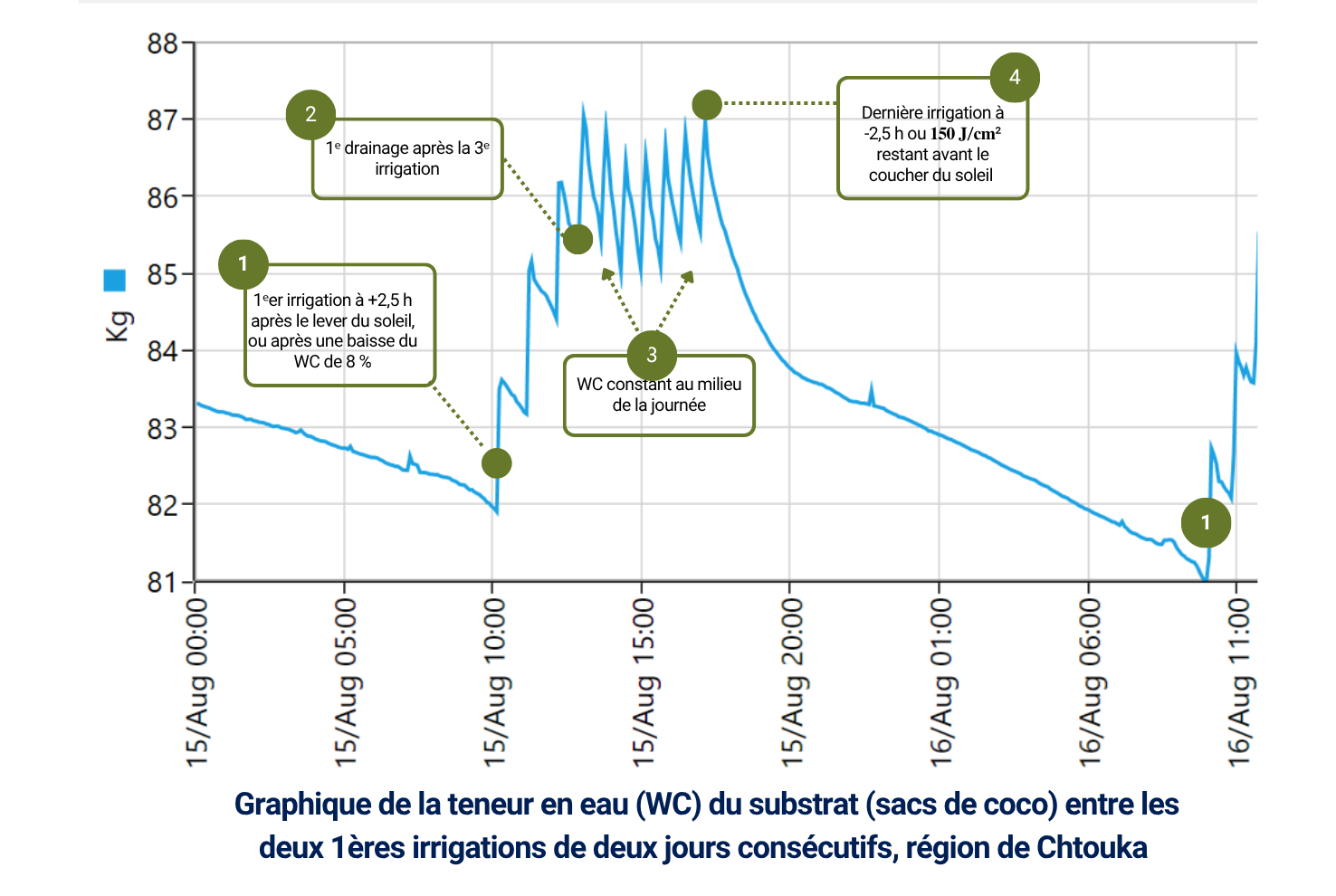
In August, the irrigation strategy needs to evolve as day length decreases. The objective is twofold: maintain a good water balance in the substrate and limit physiological disorders, particularly fruit cracking.
Last irrigation
Irrigation can be stopped approximately 1.5 to 2.5 hours before sunset, with the objective of achieving an approximately 8% decrease in substrate water content (WC) before the first irrigation cycle the following morning.
If the water content drops by more than 4% within the 3 hours following the last irrigation, a small night irrigation can be applied between sunset and midnight.
This strategy helps restore substrate moisture while avoiding an excessively early start to irrigation in the morning, which could increase root pressure and the risk of fruit cracking.
Starting irrigation in the morning
Three parameters can be used:
• Substrate weight: after an approximately 2% decrease in water content since sunrise
• Accumulated radiation: around 120 J/cm²
• Time: approximately 2.5 hours after sunrise
Daytime irrigation strategy
The first drain should be achieved no later than 4 hours after sunrise, or after a maximum of 3 to 4 irrigation cycles.
Irrigation can then be controlled according to radiation, using a reference of approximately:
3.0 to 3.5 ml of water per accumulated J/cm²/m²
At the end of the day, more precise irrigation management consists of stopping irrigation when the instantaneous radiation drops to approximately 200 W/m², or when the remaining radiation until sunset is approximately 150 J/cm².
In August, a few adjustments to irrigation timing and volumes can make a significant difference in fruit quality and crop stability.
 EN
EN  FR
FR